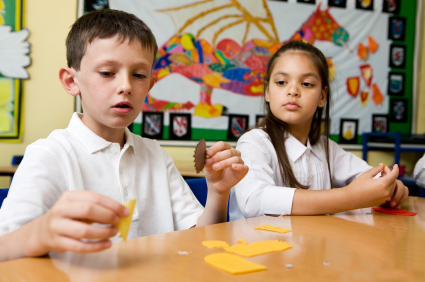
Arguing in science lab!

130415LINCOLN-SCIENCE-SQUINT-3_t670I’m unsure what Mr. Jacobs, my high school physics teacher, would’ve thought about us arguing in science lab. As much as I liked him and that class, he was a pretty by-the-book kind of guy. But argument sure would’ve made us better science students, according to new research.

This Ed Week article, called Students Learn by Arguing in Science Labs, shared information about a method of teaching science called argument-driven inquiry and a study that folks from Florida State’s Center for Educational Research in Mathematics, Engineering, and Science did with middle school students who practiced this method.

As the article laid out about argument-driven inquiry, each lab task “involves an eight-step process, beginning with the teacher presenting a problem and small groups of students choosing on their own method and experimental approach to investigate it.” I like it already – the fact that students get to make some choices about their own experimental approach. I also already admire the teachers that were part of this work, for they knew that things were gonna get messy – as they should in a science class!

The article went on to say that

The students collect and analyze their data and develop arguments to present to the rest of the class. Based on those discussions, the students may collect more data, reflect on their findings, and write up an “investigation report” that has to go through a double-blind peer review process, modeled on the peer review boards that professional journals use to screen scientific papers submitted for publication. Each student then revises his or her work and submits a final report.

Now, what came of all this, according to the researchers? What change happened to students who undertook this process? Well, students in the inquiry labs improved in science writing and in understanding of the nature and development of science knowledge, They also showed, as might be expected, “nearly twice as much improvement in their ability to use and generate scientific explanations and arguments as the students in the traditional labs.”

Science class is often too neat and tidy, with packaged lab kits that lead students to some single answer. The kits and the kids that use them often “avoid [the] intellectual messiness” that’s part of doing real science. I like this argument-driven approach, and it seems well aligned with the popularity of science, technology, engineering, and math (STEM) programs and the career readiness they’re espousing.

I got the above great pic from here.

Posted in Classroom, School, Teachers, Teaching | Tagged , , , , , | Leave a comment

Music instruction at school and its impact on learning

atlantic imageI go into many schools over the course of a year, many of which are in urban settings and serve at risk students, and if, during the time that I’m visiting, there is music playing somewhere in the building, I will always find a way to that classroom or practice room and take a few minutes to stand and listen or talk with the music teacher, if he or she is between classes. I was in a school yesterday, in fact, that during a previous visit had students playing drums and xylophones in the foyer, for all the school to hear.

Like the sound of music in a school, this article in the Atlantic, by Lori Miller Kase, caught me, made me pause, for while some schools that I visit have music programs, most do not, these programs cut to make way for more language arts and mathematics. Kase’s article and the new research that she profiles suggest that this kind of curricular cut is shortsighted, as researchers begin to discover that “music instruction not only improves children’s communication skills, attention, and memory, but that it may even close the academic gap between rich and poor students.” See this webinar from Dr. Nina Kraus, a professor and neuroscientist at Northwestern, who presents findings in this area.

For me it’s another baby/bathwater issue when it comes to school- and district-level decisions: Yes, maybe scheduling more time for math and language arts will close that gap just as well, but more often than not, that decision to winnow down what kids get during an academic day is not made as thoughtfully as possible – is not as research-based, best-practices-focused as possible. Well, here’s research coming along – what Kraus and others are pursuing – that I hope will stem the winnowing, certainly since it may have an important impact on closing the achievement gap.

The above image was at this page of the Atlantic website.

Posted in Classroom, School, School district, Teachers, Teaching | Tagged , , , , | Leave a comment

Looking around: Creating a learning environment (even without a teacher)

maker-educationMy friend Kevin Washburn (@kdwashburn) is the executive director of Clerestory Learning, author of the instructional-design model Architecture of Learning and instructional-writing program Writer’s Stylus, and co-author of an instructional-reading program used by schools nationwide. He’s the author of The Architecture of Learning: Designing Instruction for the Learning Brain and is a member of the International Mind, Brain and Education Society and the Learning & the Brain Society. Kevin’s taught in classrooms from third grade through graduate school, and his below blog post originally appeared here.

We sat, afraid to move lest we interfere with the learning and interaction we were witnessing. Children — young children — moved throughout the classroom, carrying various materials while maneuvering around tables with teapots and an occasional flower vase before landing and unpacking their selected treasures. The materials were designed to foster discovery, engage imagination, serve practical purposes, or open new worlds for students. Some did all this at once. The teacher moved intentionally throughout the room, interacting with a student about the materials currently being explored, and then moving on to another mind absorbed in discovery and learning.

After hearing about Montessori education for years, this was my first direct exposure to it. In short, I was wowed. The classrooms were abuzz with motivation. The teachers were accomplished maestros, able to conduct impromptu symphonies — in part or full — as they sprang up from student insights and inquiries.

But the most thought-provoking aspect of these classrooms was the environment. More laboratory than lecture hall, the settings posed questions and provided tools and trails for discovering answers. I was tempted to quit observing and jump into the rich learning taking place. The classrooms conveyed an unmistakeable message: environment matters!

I’ve spent years refining my teaching based on neurocognitive research, but I’ve given the environments in which I teach far less study and attention. My visit to a Montessori school reminded me that an optimal learning environment promotes exploring, thinking, and creating — whether the teacher is in the room or not.

Here are a few questions I’m now asking myself:

Are there objects within the learning space that capture interest while fully engaging learners in exploring critical concepts?

Every classroom should have books (see Question 2), but sometimes the mind learns better in more physically active ways. Remember the Rubik’s Cube craze, launched by a toy designed “to help explain three-dimensional geometry”?Children and adults — possibly one-fifth of the world’s population in the mid-1980s — spent hours a day handling and thinking about how to solve the colorful and confounding puzzle. Every twist prompted a new challenge or success as young minds worked to solidify all six of the cube’s sides. The relationships between the sides of a cube had never before captured such attention and thought.

In Montessori classrooms, the materials were often less complex in construction than the Rubik’s Cube, but they proved equally engaging and thought-provoking. They were simple enough to use but still intriguing in the ideas they helped children explore. Many simultaneously occupied hand and mind.

Are there ample materials to spark individual exploration, learning and mind-enriching entertainment?

I’m old enough now that students from my first years of teaching — fourth-graders — are adults. Several have found me via social media and a few have met me for lunch when I’ve been nearby. Almost every one of them remembers one thing about my classroom: books! I was inspired by a college professor whose office looked like a great children’s library, and I set out to give my classroom the same feel. The longest wall in the classroom held its windows and my book collection. In those pages, students discovered the inhabitants — and food — of Redwall, met children who sneaked gold past Nazi soldiers via sleds, and were shocked by the literal and metaphorical wolves of Willoughby Chase. The environment was rich with potential, and many students who came into fourth grade thinking they didn’t like to read went into fifth grade possessing a rich background in children’s literature. While I did what I could to stoke such interest, it was the presence of the books in the classroom that made the difference. They allowed students to wander, to wonder, and to discover worlds on their own.

Is there a sufficient variety of materials to allow students to process material in self-selected ways?

Technology is great. It connects us to resources, and even experts, around the world. It’s incredibly mobile, available and almost intuitive to use, and yet…sometimes human energy rather than battery power fosters better learning.

I recently taught a course focused on merging what we know about learning from neurocognitive research with the potential represented by wise use of educational technology. In one activity, the participants follow a sequence of actions to construct new understandings of a recent historic event and the background of one individual who played a significant role in it. Throughout the activity, the participants are free, invited and encouraged to use any technological tools they’d like, for any purpose, and at any time. After all, the purpose of the course is to get teachers comfortable in using technology more widely in their classrooms. Throughout the search for related information, phones, tablets and laptops are the center of activity. The same is true when the participants reach the point of producing evidence of their learning. However, in between these activities, the tool-of-choice shifts. During processing, the overtly thinking-centric steps in the sequence, most participants turn away from their screens and make a beeline for more “traditional” tools. Paper, pencils, chart paper, markers, crayons, sticky notes, index cards — these are tools most still reach for when thinking is the target activity. This proves true regardless of age. Young teachers, the early 20-somethings, and experienced teachers, the beyond-20-somethings, prefer a utensil other than a phone in their hands when they need to sort out new knowledge and examine it for patterns. Eventually, the sorted facts and discovered patterns get presented to others via technology, but when cognition is the thing, other tools prevail.

This is NOT to say that no one uses technology to sort information. In fact, a few do — or at least they start that way. I’ve witnessed several young teachers begin with a phone or tablet in their hands only to abandon it when they realize the “traditional” tools promote greater efficiency and flexibility, and possibly improved thinking.

Sure, technology has a place in the classroom these days. But when choosing materials to have on-hand within the learning environment, remember that sometimes the mind prefers to process ideas with a pencil (or crayon, or marker) in-hand.

In Unthink, artist and writer Erik Wahl reminds readers that in childhood we were free to sculpt our “days into works of art…filled with joy, enthusiasm, and fulfillment.” He explains that we operated that way because we needed to be “mass collectors of information,” because we were “cross-training for the many scenarios life would eventually toss at us in rapid succession.” For such training, we needed environments that were “rich, vibrant, and imagination-fostering.

Our classrooms should be environments that equip and enable such cross-training.

Look around. What is in your learning environment now? What should be there? What could keep learning happening with or without you being present?

Posted in Books, Classroom, School, Teachers, Teaching | Tagged , , , , , , , | Leave a comment

Teach Elmore Leonard’s Hombre!

bildeI loved this Elmore Leonard novel, easily my favorite of the Leonard books that I have read, and part of the reason that I loved it was because I could imagine teaching it. It has the layers that make a book fun to teach, particularly with middle and high school students.

It has a fast-moving plot that makes its 200 or so pages flash by – even though Leonard is playful with the novel’s structure, the narrator telling us that there may be other versions of this story but that his version is the truth. There are economically and wonderfully etched characters, all highly believable, all flawed in some manner. The taciturn protagonist John Russell: Are his actions driven simply by self-preservation, or is there some underlying goodness to what he aims to do, even amidst the hate and discrimination that’s heaped upon him? And there are thoughtful, discussion-worthy themes, such as the issues of identity and the past and attempts to escape/hide from both. The book’s last 20 or so pages could fuel thoughtful discussion in sophomore English for a week.

For several years, when I was in my full-of-myself 20s, I thought the sort of books that Elmore Leonard wrote were not worth reading. They were dreck, not worth the time. Better to trudge through Hardy’s Jude the Obscure – and be bored stiff – than read something that might be more – dare I say – pleasurable. Well, thank goodness that past is behind me – way, way behind me – and thank goodness for books like Hombre, books that are both thrilling and thoughtful. My next read? Leonard’s Valdez is Coming.

Posted in Books, Classroom, Teachers, Teaching | Tagged , , , , , , | Leave a comment

Talking and listening

RV-AL726_TALKER_G_20131004140358This weekend’s Wall Street Journal had this great piece by Rob Lazebnik – called It’s True: You Talk Too Much – and it brought me back to a post I did in June on developing good question-askers.

In the article Lazebnik quotes Dr. Lynn Koegel, clinical director of Koegel Autism Center at the University of California, Santa Barbara, saying that “an optimal conversation flow has each person talking about 50% of the time.” And how is that flow achieved? By asking questions. By actually listening “to what the other person is saying” and finding openings for questions, as Lazebnik writes.

As I wrote in my June post, teachers can train students to be good question-askers, and schools can develop whole cultures around being attentive to others and inquisitive about what they’re saying. But it begins with the adults in the school, before it gets to the kids. Those adults have to know how to listen and ask effective questions before they can teach their charges to do the same. And maybe a starting point for adults in a school is a survey built from Lazebnik’s observations: “Do you notice that people at parties always excuse themselves to get a drink when you start talking?” Seriously. I could see a school leader having fun with her staff, before they get to the hard work of changing behavior. Maybe even using a stopwatch to time people talking during the staff meeting on this subject.

Well, they can at least start by reading the Lazebnik article.

I got the above image from the Journal’s website here; it was done by Serge Bloch.

Posted in Classroom, Parents, School, Teachers, Teaching | Tagged , , , , , , | Leave a comment

On seeing your teacher at the grocery store

Century -Piggly-Wiggly-Supermarket_03There is that story that teachers tell about seeing a student outside the context of the school building, the student completely flummoxed by the teacher being in, say, the grocery store or at the gas station. “I’d thought you lived at the school,” the student’s reaction seemed to say, a vision of a cot in the classroom, a hot plate for soup and boiling eggs, a TV hidden in the closet so that that beloved but mysterious teacher could watch the news while boiling those eggs. (For 12 years I taught in and lived at two boarding schools, overseeing dormitories of mostly sophomore and junior boys. When I was on duty in the dorms, the door to our apartment was open, and students came and went. Students in those settings – about 0.5% of school-aged young people – have a very different reality, as do teachers.)

Recently, I had some back and forth with friends about teachers at the opposite ends of the pole: One teacher who has a hard shell, allowing little of his private life to infiltrate his teaching, another who has an easy manner with her students and uses past life experiences – her own – to explain and build on what’s happening in the classroom. I have known many teachers at these ends of the spectrum – and many in between – and their places on this spectrum do not predetermine effectiveness. In the past I have written about my high school physics teacher Mr. Jacobs and his significant effectiveness in the classroom; he was also a teacher that I knew nothing about outside of school. A complete cipher, but I loved him and his class, and I learned a ton about physics.

As the parent of a middle schooler, I wonder if a hard shell is the best way to get to middle school students. They desperately want connectedness these middle grades years, with their peers and their teachers, and a hard shelled teacher does not seem the best way to get there.

But I’m being too narrow in my thinking. Research about the student-teacher relationship and its impact on learning is just that – about the relationship. Sure, there are effective strategies to help develop that relationship, but they can be as varied as the teachers that implement them – teachers that range from the hard shelled to the open and easy-going. The key for all teachers, I guess, is a belief in the importance of that positive relationship, for when “students have a positive teacher-student relationship, they adjust to school more easily, view school as a positive experience, exhibit fewer behavior difficulties, display better social skills, and demonstrate higher academic achievement.” (See this paper here or this one here.) Powerful consequences, huh?

It’s all rooted in respect, right? That when students respect their teacher and feel respected by that teacher, that relationship can be very, very solid. I didn’t need to know about Mr. Jacobs’ life outside of school – about the boiled eggs that he had for dinner each evening, his cot and hot plate hidden in the classroom’s closet, ready to be set up when we left the building. I just needed to know that he respected my nascent physics mind, which he did. That’s hard for me to believe, given what a dope I was in high school, but it makes me admire him even more. He got through to us by being respectful, by engendering respect in him, and by sharing his deep respect – his love – for the material. Funny to think how much I remember that class and him, almost 40 years after.

Posted in Classroom, School, Teachers, Teaching | Tagged , | 1 Comment