Qatar, its educational system, and books

Qatar's financial center

A former colleague and current teacher is spending the year with her husband in Qatar, and she blogs about it here. She had a great post about Qatari schools and schooling, of which I have taken a large snippet. Thanks, Cheryl, and enjoy the snippet, dear readers.

As a nation, Qatar sits pretty high on the ‘have’ end of things, and there are schools galore here. State organized education began quite modestly back in 1952, with a single primary school enrolling 240 boys taught by half a dozen teachers; while the system has been growing since then, the vast majority of that growth has been quite recent, as part of the ‘modernization’ of Qatar under the current regime. The Supreme Education Council (SEC) assumed charge of state education about four years ago, taking over from the now-defunct Ministry of Education. One of the things the SEC has accomplished is the development of a standard curriculum – more on it in a minute.

Education today is open to both boys and girls, but all state schools (called ‘state independent schools’) are divided by gender. At present, there are 137 state independent schools in Qatar: 67 for girls and 69 for boys. (I wonder how long this separation will go on; one of the long-term effects will certainly be an exacerbation of the current challenging issue of conservative Qatari women refusing to work in any situation where men are present – but that’s a whole different kettle of fish.)

Qatar Academy

While neither money nor an appreciation for education is lacking at the state level, that’s a fairly recent state of affairs, and the educational system is not without its share of interesting challenges as it works its way through growing pains. One of the biggest challenges for the state independent system is that there are currently no state schools using the SEC curriculum that are internationally accredited. That accreditation is greatly desired because among Qatari, an institution of higher education in the UK or US is most preferable. (One state school – a girls’ school – does have it, but they use the IB curriculum, not the one designed by the SEC.) Another issue in state schools is that English is taught as a second language, but all other classes are taught in Arabic; thus English fluency is not nearly what it needs to be for many graduates even to qualify for university regardless of their grades in other classes. And last but by no means least is the issue of what’s really being learned: while the royal family might be promoting the importance of education, the concept hasn’t necessarily filtered down to students yet. Or their parents. Though teachers in state schools are native Arabic speakers, few are Qatari, and the prevailing social stratum of Arabic nationalities here not-so-subtly assumes that Qatari children will receive passing marks, no matter what. Not all those who attend state independent schools are Qatari (though most are), nor do all Qatari children attend the state independent schools.

Logo for Bangladesh M.H.M High School and College

Because the international and expatriate population is so enormous (and often temporary, with one to four years a common ‘stint’), there is a plethora of other schools, many catering specifically to a particular nationality. There are schools for Sudanese, Lebanese, French, Indian, Pakistani, Philippine, and Canadian nationals, each taught in that particular language and each with a curriculum lifted directly out of schools in the respective nations; children can thus transfer relatively seamlessly from their home school to the one in Doha and back again when the family moves home. In addition to state independent schools (which use the SEC curriculum) or national-specific schools (with their home curricula), there is a whole raft of what are called ‘private independent schools’ with other curricula: Montessori schools, schools that follow the National Curriculum of England and Wales, ones that use the Cambridge IGCSE, or the IB and/or AP curricula.

One such school – the British Newton School – is across the street from our compound; I will spare you the gory details of what morning drop-off is like, but I’ve rambled on enough about driving in Doha. Just add a ridiculous number of pint-size pedestrians, undesignated street side parking on both sides of the road, perennially rushed parents, and a complete disregard for through traffic into the mix; shake well, step back, and let your imagination take over. It’s a treat.

These schools all have an application process (and fees, of course); the population at them tends to encompass multiple nationalities, and the language of instruction for all classes is English. And here is where you will find some Qatari children, mostly from wealthy families: at schools where there is an internationally accredited curriculum in place taught in English by teachers who will hold the Qatari children as accountable as their peers from other nations, and where graduating with commendable grades will qualify the student for university.

The issues that state independent schools are grappling with are pretty easy to identify, and while addressing and correcting them won’t be easy, there are definitive steps that could be taken. Also, the schools and the SEC policy wonks have a decent amount of control in making the necessary change happen in order to achieve the desired outcomes.

That’s not the case with at least one larger issue at play: this is not a reading culture. This is understandable given the historically short period of time they’ve been a modern society. Still, that’s an imposing hurdle to clear from an educational mentality – in the US, there’s a saying about third grade being a transition year from ‘learning to read’ to ‘reading to learn,’ and that’s no small transition. A significant portion of a successful student’s knowledge base ultimately comes from reading.

Jarir Bookstore

I don’t mean to imply that the Qatari can’t read and write; they definitely can. The literacy rate here is very high and in addition to their native Arabic, most Qatari can speak reasonably good conversational English. But that doesn’t translate to fluency, not by a long shot, and there doesn’t seem to be any perceived value in using the skills they do possess to read for education or enjoyment. A trip to any of several local retail establishments labeled ‘bookstore’ will make this clear. My favorite of such is called Jarir Bookstore; the logo includes the phrase “…not just a bookstore” beneath the store name and it’s not kidding. The particular store I like to visit (Jarir is a chain) is brand-new and quite big – almost the size of your basic Barnes & Noble or Borders store in the US – and it’s two floors.

You won’t find a single book on the entire first floor. What you will find are computers, video games, a staggering array of office supplies, and an impressive variety of fine art and drafting supplies, but no books (to be fair, the magazines and newspapers are on the first floor). On the second floor, there are more arts and crafts supplies, a selection of educational toys for the primary school set, and finally books. The books take up about half of the available floor space upstairs, split evenly between English and Arabic titles. The English section has a bit of everything: a decent selection of classics, an interesting assortment of textbooks, a hodge-podge of what look like books from the ‘Bargain’ display at a B&N, and three small aisles of fiction. Recent titles and best sellers are among the titles for sale, but browsing was definitely challenging: the fiction is arranged strictly by author’s last name regardless of genre, and so mysteries, popular fiction, science fiction and romance novels are oddly juxtaposed; I will say it made for some amusing book-neighbors. Still, it’s heartening to see books readily available; I’ve a friend who has lived in Doha for nearly four years, and when she and her family moved here, books were scarce. Even more heartening is the wide selection of children’s books available in the Arabic language section; clearly, the powers that be recognize the need to encourage a love of reading at an early age.

Qatar's first lady, Sheikha Mozah bint Nasser Al Missned

One of the driving forces behind fostering the growth of education in Qatar is Her Highness Shiekha Mozah, and one of the things she’s paying a lot of attention to is changing the cultural attitude about reading. I saw one of those initiatives in full force on the day I visited the Doha International Book Fair, a ten-day event held at the Doha Exhibition Center back in November. The Exhibition Center was absolutely packed: in addition to an impressive number of adults, there was what can only be termed as an invasion of very young school children on field trips to the fair. (One of the most adorable sights I’ve seen in a very long time was a class of four-year-old boys – thirty-two of them – being shepherded through the fair by their abayah-clad teachers. The boys were dressed in school uniforms of navy shorts and light blue shirts, all huge solemn eyes and dark hair, standing two-by-two before a table covered with brightly colored paperback preschool books. Each boy was clutching a glossy yellow plastic bag in one hand and most held their marching partner’s hand with the other as they waited patiently for their turn to approach the table and choose a book, which the vendor dropped into proffered bag. I might actually have uttered an audible awwwww as I passed them.) I saw other groups of school children all holding similar yellow bags, and I’m guessing that taking a book home was part and parcel with the field trip.

While I wandered through the fair (which housed nearly 30,000 titles in Arabic and over 7,000 titles in other languages), I noticed that a significant percentage of books and educational ‘learning-to-read’ toys were aimed at the ten-years-and-under age group. I remember thinking that it was pretty much a kid’s dream to wander amongst the aisles, and that I’d be hard pressed to choose just one book; obviously, that’s the point. Start the reading early and often and encourage, encourage, encourage.

Camel crossing

In the meantime, there are the kids moving through the educational system as it (and they) are right now; it’s definitely a work in progress. That’s fair enough. When your people have made the transition from fishermen and nomadic camel herders to inhabitants of a 21st century city in two short generations, that doesn’t allow a lot of ramp-up time to get everyone accustomed to the wonders (and rigors) of ‘good education’ or, in fact, to even necessarily define what a ‘good education’ means in the context of your country’s development and long range goals.

Case in point: an article in the January 18th edition of The Peninsula (one of the Doha daily newspapers) reports that the Qatar Center for Heritage and Identity, in collaboration with the Supreme Education Council, is planning to introduce Qatari heritage to the curriculum. The center plans to form groups in preparatory schools to promote Qatari national heritage with the goal of ‘bringing about a unified vision for the next generation.’ Admirable.

Posted in Books, Federal policy, School | Tagged , , , , , , , | Leave a comment

Mathematics musings: the Common Core, algebra, and instruction

I got math on the brain. Scary, I know, for an old English teacher.

It started when a friend tweeted this article about a charter school in San Diego that had revamped its math curriculum so that their kids would be better prepared for algebra. The school found that its students “were developing too many shortcuts and not enough understanding.” They were procedurally compliant, it seems, but were not developing deep conceptual knowledge. When these previously mathematics whiz kids hit algebra, their test “scores plummeted.”

The article shared this graphic from the San Diego school district:

For more on this procedural/conceptual dynamic duo, see this transcript and video from Harvard’s Jon Star. (Full disclosure: Jon and I co-wrote this piece for The Center for Comprehensive School Reform and Improvement.) Jon states that “procedural knowledge and conceptual knowledge develop iteratively, that they sort of feed into one another…It’s not so much that if you only do procedures then the concepts sort of develop by themselves or if you only do concepts for a long time then when you get around to the procedures, they’re super easy. We haven’t found that to be the case.”

It was interesting that the San Diego school saw scores fall when kids hit algebra, given the importance of this subject matter. The final report of the National Mathematics Advisory Panel stated that algebra “is a demonstrable gateway to later achievement. Students need it for any form of higher mathematics later in high school; moreover, research shows that completion of Algebra II correlates significantly with success in college and earnings from employment. In fact, students who complete Algebra II are more than twice as likely to graduate from college compared to students with less mathematical preparation.”

Unfortunately, mathematics teachers generally feel that students are not adequately prepared to take Algebra I, as shown by this report on the National Survey of Algebra Teachers, with data collected from 743 of them in the spring of 2007.

My circuitous math path continued. There was the article on the San Diego school, and then the other night at my son’s school’s PTA meeting, there was a quick report on the just finished work and recommendations of our district’s K-12 Mathematics Joint Work Group, which had been charged with exploring “the complex issues surrounding mathematics teaching and learning in” the district and developing “recommendations on ways to improve student achievement in mathematics system-wide.” The group was formed about a year ago and ultimately devised this set of recommendations, after 18 meetings:

  • Revise and align written curriculum and assessments to the Common Core State Standards
  • Curriculum resources that support equitable preparation
  • Eliminate large numbers of students skipping grades
  • Continue programs for consistently, exceptionally proficient
  • Refocus targets
  • Online collaboration supporting evolving curriculum
  • Professional development supporting content and practice
  • Aligning school structures and strategies
  • Formative assessments to improve teaching and learning
  • Assessing mathematical proficiency

I’m unsure what some of these mean – “Aligning school structures and strategies”? – but I was interested to read about “students skipping grades” and the need to “refocus targets,” and more is said about these issues in this Washington Post article, posted at this blog. The article states that these new changes come “as high school teachers were increasingly saying that even their advanced students were arriving in class unprepared…School officials said more than half of fifth-graders are taking sixth-grade math or higher.” A district deputy supe stated that it “was better to tackle topics in greater depth.”

Alignment to the Common Core will drive more in-depth study. See this slide from the PowerPoint deck that the math work group used for its final presentation.

As I compare the two, I’m struck by the coverage (I use that word pejoratively) that happens now with our district’s curriculum – that, for example, algebra study spans all grade levels, with little intensity of focus at any one – while the Common Core demands intense study. Look at 8th grade, as students dive deeply into mostly algebra and geometry. No more mile wide, inch deep.

What interests me a great deal, when I think about these new standards and their new approach to subject matter, is teacher training. Many states that have adopted the Common Core feel the same way. According to a recent report from the Center on Education Policy, 44 states have fully or provisionally adopted these common language arts and math standards, 33 plan to make changes to professional development for teachers, and 21 of 33 plan to do it by 2012 or earlier, an ambitious undertaking.

Let me see if I can circle back to my start: The kids in that San Diego school became procedurally compliant because they were taught that way, and to make changes in that school district, “thousands of teachers have been trained in the new [teaching] methods.” These new methods evolve from, as the National Mathematics Advisory Panel stated, “a more advanced perspective [of] the mathematical content [teachers] are responsible for teaching and the connections of that content to other important mathematics.” Denise Mewborn, Professor of Mathematics Education at the University of Georgia, stated in another piece I wrote for The Center that teachers “need to learn to solve a problem several different ways, compare and contrast the various solution strategies, explain the connections among the strategies, explain why each strategy works, and consider things such as which strategies they would highlight in a classroom situation, for what purpose, and in what order.”

All of this suggests a significant facility with mathematics, an expertise that comes with deep knowledge. Yes, new texts and materials that are aligned with the Common Core will be critical to student success. But even more important will be the ongoing training that teachers get, a mix of content and methods. Elementary school teachers will be the busiest. They are critical to the success of this Common Core initiative yet have more than mathematics to teach. States and districts must think carefully about professional development for them, to ensure that they are prepared for this change. Will they be ready to, as Denise Mewborn wrote, “solve a problem several different ways, compare and contrast the various solution strategies, explain the connections among the strategies,” and “explain why each strategy works”? Whoa: That is a lot. But that sounds to me like a darn interesting and valuable class – and a class that will prepare students for thoughtful and successful mathematics study in the future.

Posted in Classroom, Federal policy, School district, Teachers, Teaching | Tagged , , , , , , , , , , | Leave a comment

Going to school in Nigeria

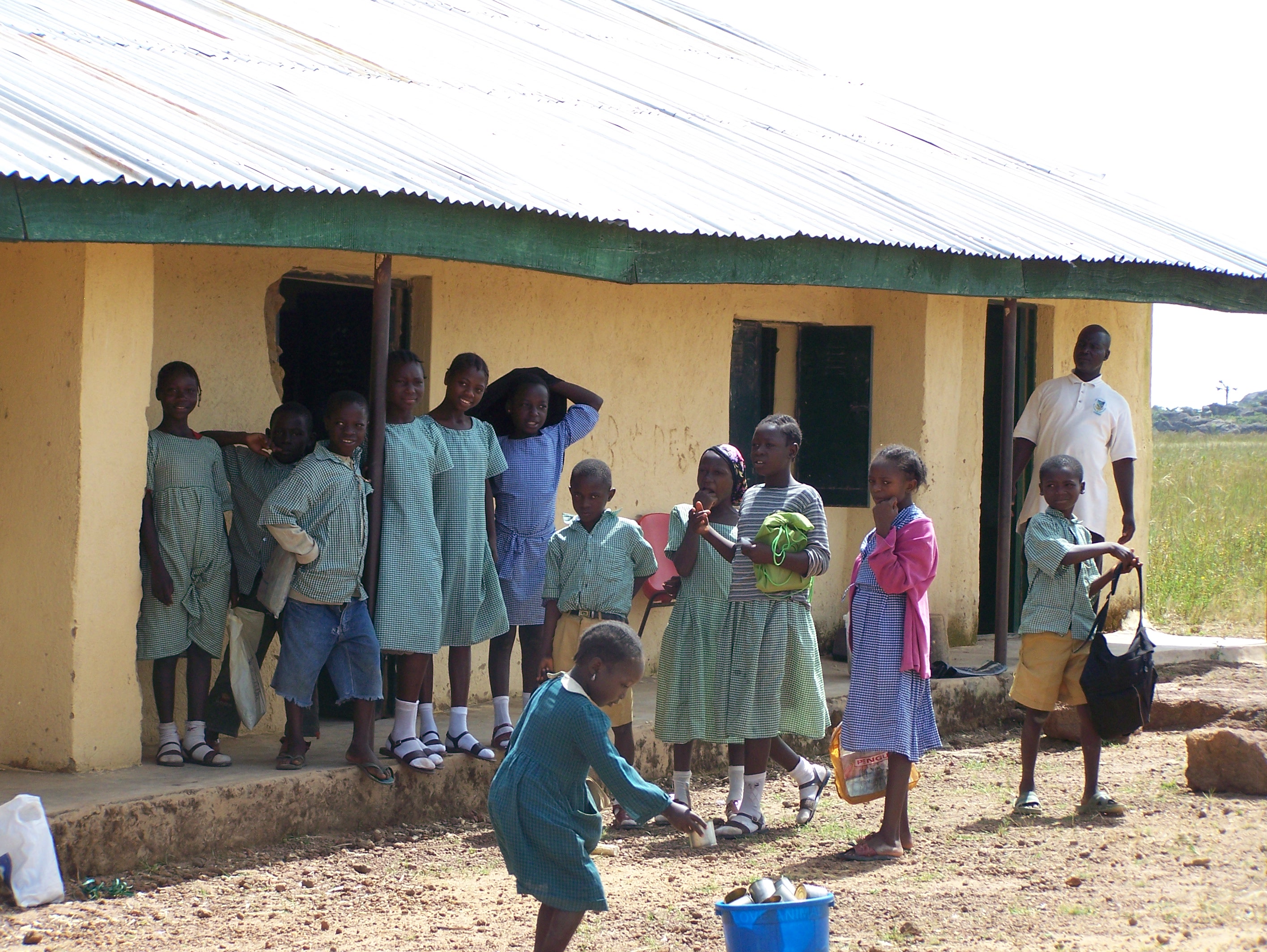
Outside a local school

I have a good friend from college, Brian Hitchcock, who’s living near Jos, Nigeria this year, running the work of his non-profit Self-Sustaining Enterprises (SSE). You can see the website for more info on SSE and the blog that Brian and his wife Karen write.

I asked Brian to tell me about schools and schooling in that part of Africa, and he wrote that public education in Nigeria mirrors the US “in that they have pre-primary (K), primary (grades 1-6), junior secondary (7-9), and secondary (10-12). Children start school at age five, and the year is broken into three terms. They have the months of June July, and August off.”

Brian continued: “Generally, the government pays teachers and builds the school, but parents are responsible for maintenance and provision of anything beyond a basic allotment of things like desks. Consequently, many schools lack basic needs such as enough furniture for the students, decent toilet facilities, clean water, and a roof that doesn’t leak during the wet season.

“School is free up to grade six except for paying for uniforms and books. Books cost the equivalent of $20 US. Additionally, a family has pay about $2 per term per child for supplies, e.g., chalk, paper, etc. The government supplies the teachers’ books.

“From grades 7-12, the family has to pay about $50 at the year’s start and about $20 the second and third terms. After 9th grade, they pay about $7.00 as an exam fee. The student has to pass the exam to move on, and at the end of the 12th year, the student has to pay an exam fee equal to about $70. A student must pass all exams to graduate, and often students do this in bits and pieces for a couple of years. This is often due to the cost but also to the accumulation of missed school resulting in deficiencies in some subjects.

“Since the fees go up at 7th grade, many children don’t progress pass 6th grade, and since there are expenses for school, even though they are modest for primary school, there is a family hierarchy for school attendance. Boys are first in line, girls are second, boys from extended family third, and then girls from extended family. So many families here include children from family members who have died. There aren’t many institutional orphanages, and children who have lost their parents will live with aunts, uncles, grandparents. This is an added burden to already struggling families, and these children are last in line when it comes to school.

“The core curriculum for Nigerian schools consists of mathematics, English, science, and social studies. A student has to have attendance of at least 75%, not including strikes or government school closures. They don’t have snow days here, but in Plateau State where we are, they have crisis days when there is civil unrest and the schools close.” Read about some of the recent violence in Jos here.

Brian continued: “School, by government mandate, is supposed to be taught in English, the official language of Nigeria. The country has three main language groups – Hausa, Igbo, and Yoruba – with hundreds of dialects. Often, teachers in local schools are not fluent in English and teach in the local language. Students then are not prepared to pass the exams because they can’t read, write, or speak English effectively.

“The lack of qualified educators is also a big problem. If you are the product of the schools I am describing, is there much chance that you are well prepared to be a teacher?  The problem of qualified teachers is even greater in the rural areas, as there is not much attraction for a young teacher to start his or her career in the ‘bush.’

“Nigerian teachers can go months without getting paid. Often, tired of not getting paid, the teachers strike, and these strikes can last for long periods. The entire primary education system missed a school year recently due to a teacher strike. Though not always this long, there have been strikes almost every year for the past 10. You can’t blame the teachers; it’s tough to make a living when you are not being paid.”

Most of Brian’s information is about schools in the city area; schools in the surrounding rural areas are a more sad story. Brian wrote: “Attendance at the primary level in the area where SSE focuses its work is about 35%. Most children are registered for school, but only 35% are there on any given day. Imagine trying to teach and keep progressing when only a third of the children were there the prior two days. This absenteeism is due to several reasons: lack of water, sickness, and family needs. Children, for example, have the task of fetching water for the family, water that is scarce during the dry season, which encompasses most of the school year. The children get up early – so that they can beat the animals to the water hole, since the animals stir up the water and make it cloudy – and they walk four to five kilometers to fetch water. By the time they return home, they may be late for school and are exhausted. Rural parents, in general, don’t have a high regard for school, and children will just stay home.

“Even if water is more accessible, it’s probably not clean water. At a rate as high as 40%, rural children die from preventable and treatable water borne illnesses before the age of five. Those that survive often suffer from chronic illness and stunted growth.”

The education center's dedication

Brian finished by saying that he, Karen, and SSE have started the Oasis Learning Center where they are, with future plans to build a boarding school that will bring together elite children from families with money and village children. “Those with money who pay fees,” Brian finished, “will help subsidize those from the village who are unable to pay much.” Brian wants to form relationships with schools in Europe and the US to give the local Nigerian students chances for further education.

Read more at SSE’s blog and see photographs of SSE’s work and the local people here.

Posted in Classroom, School, Teachers, Teaching | Tagged , , , | Leave a comment

Happy the beagle

Sort of like Happy

Being home over the holiday got me thinking about school and the town I grew up in – and Happy the beagle.

I used to take that dog to school. My brother Jeff and I would walk there – it was about a mile – and back in those days, before leash laws, Happy would follow us and hunker down under my desk, until he got bored and went out the door on the side of the classroom and headed home.

Living in Hanover, NH, near Dartmouth College, our house a short walk to the banks of the Connecticut River, we raised beagles and watched as our female Sally went into labor and delivered six, seven, eight pups, wet, eyes closed, their coats bright against the blankets of Sally’s birthing box. Happy was one those pups.

Happy was not with us when we walked home from school, which was never in a straight line. We stopped at Omer and Bob’s Sports Shop on Lebanon Street, and most of the time both Omer and Bob would be there. We got hard candy and tried on skis and patted Omer’s dog. We’d then be off to our next stop. It might be Leverone Field House, over near Dartmouth’s football field, or Davis Rink, where my father was putting his team through drills. In the back of the rink, the Zamboni dumped its snow, and we’d pelt each other.

Teletype with paper tape reader

At Kiewit Computation Center, if there was a terminal open – Dartmouth students had preference over eight-year-olds – we’d sling our books under a desk and pull chairs around so that we could play the computer games of the ’60s. First, you decided which to play: Football or Monte Carlo car racing. Then, we fed a punched tape through a reader, to boot up the game. Play was simple: When asked by the computer – and keep in mind it was a paper teletype, not a CRT screen – I typed in the MPH I wanted my car to speed around the first hairpin corner. My friend John would do the same and then, with great noise and shuddering, the teletype printed out a screen shot of where each of us was on the race course – or we had wiped out, spinning out of control due to our speed. If we played football, it was programmed to pause at some point, typing out that a dog had got out on to the field. Maybe it was Happy.

I wish that I could remember more about the elementary school and my time and classes there, as I think they were fairly idyllic. In kindergarten class we built this huge replica of the Santa Maria – it seemed huge to me – one that we could get inside and play on. In the third grade we had a large Greek history unit, with a culminating festival at its end. There was food, a procession, costumes.

Puck on Occom Pond

What I remember more is wandering that town – our playground – which suggests that our wandering, that our play, impacted me far more than school. It was more rich than school, it seems. We might be down at the banks of the Connecticut, damming some rivulet with sticks. Or walking on a dark snowy morning to hockey practice and directing traffic since the stop light was out. Or at a frozen Occom Pond, our mother leaving us for the day, with our skates and sticks and helmets and lunches. She retrieved us well after dark, the lights on at the pond. No matter how cold we were, she always had a hard time pulling us off the ice.

I guess there’s nothing wrong with this picture, since I turned out all right. But it reminds me that our kids – my kid – have the same tugs, between in-school and out-of-school. I also understand that my small-town experiences of 40 years ago are very different than for many young people, as their out-of-school world can be very lonely, very scary. This 2009 piece by the Afterschool Alliance begins by stating that for many adults “thinking about the hours after the school day ends conjures up memories of doing homework, playing pick-up basketball, taking guitar or dance lessons or going home to Mom and a snack. But for millions of children today, those images are nothing like their reality. In fact, each day in America, some 15 million children – some as young as five years old – are without supervision at home or on the streets.” My memories are of out-of-school; for many children their memories are made in school.

Yup - a yearling moose

My mother recently gave me a photograph, one of me and a friend playing wiffle ball in the side yard, near the weeping willows. Just after she took that picture, a moose marched by our house. It had come up from the river, and my friend and I followed it up Maple, over to Sargent, before it crashed back into the woods. Did I bring that sighting to school with me, as I did my dog? What did I tell my teacher? And what did she tell me about moose marching up streets?

My son and I decipher experiences all the time – the red-tailed hawk being chased by crows, water striders and their use of surface tension, the decomposition of a squirrel road kill – and I want there to be a seamlessness between the outside world and the world of school. I know that some schools and many skillful teachers knit them together brilliantly, and what comes from that knitting can be deep and meaningful learning for young people. Metaphorically, school needs to be a place where Happy the beagle can still sit under a student’s desk.

Posted in Classroom, Parents, School, Teaching | Tagged , , , , , , , , , | Leave a comment

Tuesday Tidbits, December 7, 2010

There are interesting things happening at the Big Ideas Fest, which started on Sunday, out in sunny Half Moon Bay, CA. Martha Kanter from the Department of Education shared this YouTube clip at the kick off:

One of things highlighted at the Fest were Siftables – “cookie-sized computers with motion sensing, neighbor detection, graphical display, and wireless communication.” Very cool – here’s a TED talk on them:

I got to the Siftables stuff from the MindShift site powered by KQED; there’s much other good stuff there. For example the post about Dr. Sugata Mitra and his belief that we need to give kids the benefit of the doubt when it comes to handling what’s perceived as adult-only information. Allow children to self-learn and let parents and educators be guides rather than sources of info. Certainly, there’s no going back, with the internet genie out of the bottle.

Lastly, I had not heard of this place before but like many of the reports there – the National Education Policy Center at the University of Colorado. Happy reading!

Posted in Federal policy, Teaching | Tagged , , , , , , | Leave a comment

Does class size matter?

Many moons ago – summer of 2009 – there was an AP piece about the increase in class sizes across the US and further chatter on blogs like Eduwonk and the like that it isn’t really about class size but more about teacher effectiveness – which is right on. An effective teacher is far more important than smaller classes – at least the little-here-little-there small that school districts tend to implement. As researcher Eric Hanushek said in the AP story, “All the research suggests the number of kids is much less important than who is teaching the class.”

Friends have asked about this issue, and below is something that a former colleague of mine pulled together on it for our PTA. (See it also here.) Yes, it’s a little wonky but gives a sense what the research says about class size and its impact on achievement, student behavior, and teacher satisfaction.

Here goes:

Class Size and Impact on Student Achievement/Performance: The one seminal study – known as the largest, best-designed experiment on the impact of class size – is the STAR Project (Mosteller, 1995), completed in 1995. This longitudinal study controlled for unwanted variables for which previous studies on class size had been criticized, such as teacher training, socioeconomic background, and curriculum material and programs. The results showed that (1) long-term exposure to small classes (in grades K-3) generated substantially higher levels of achievement and the (2) extra gains associated with long-term exposure to small classes were greater the longer students were exposed to those classes. In addition, although all types of students experienced extra gains from long-term exposure to small classes in the early grades, those gains were greater for students who are traditionally disadvantaged in education.

The study also showed that students who were exposed to small classes in the early years were able to sustain the advantages in achievement as they moved on to upper grades. The students were months ahead of those from standard classes on the local standardized test, earned better grades, and dropped out at a lower rate. In high school these students took more advanced and foreign language courses, graduated at a higher rate, and volunteered to take college entrance exams at a higher rate than students not exposed to small class sizes in the early years. Additional conclusions drawn from STAR include:

  • The extra gains found for long-term attendance in small classes (in the early grades) continued to appear when students were returned to standard classes in the upper grades
  • Extra gains associated with long-term attendance in small classes (in the early grades) appeared not only for tests of measured achievement but also for other measures of success in education
  • The greater gains experienced by students from groups that are traditionally disadvantaged for education were retained when those students were returned to standard classes (Biddle & Berliner, 2002)

Other studies conducted in Wisconsin (SAGE Program) and California (Class Size Reduction Program) have offered valuable lessons in regards to the effect of class size. First, implementation of small classes has to be planned thoughtfully and funded adequately. Also, extra gains in achievement from small classes are larger when class size is reduced to less than 20 students (Biddle & Berliner, 2002).

Class Size and Impact on Student Behavior: Finn, Pannozzo, & Achilles (2003) reviewed 11 studies on the relationship between class size and student behavior. Their review found:

  • Students in small classes contributed more to class activities and paid more attention in class
  • Student engagement in academic tasks was higher in small classes than larger classes
  • Overall, most of  the studies showed a positive impact of smaller classes on students’ social behavior by decreasing antisocial behavior and promoting prosocial behavior
  • Students in small classes are less likely to be disruptive
  • Smaller classes appear to promote an atmosphere in which students are more supportive and care about each other

A study by Koth, Bradshaw & Leaf (2008) showed that 5th grade students in smaller classes tended to view the school climate as safer, especially in regards to order and discipline. The authors stated that class size alone may not be a great influencer of school climate and student behavior perception.

Class Size and Impact on Teacher Satisfaction: Research on class size and impact on teacher satisfaction is scant; however Finn et al. (2003) reviewed nine studies and found the following:

  • Teachers in small classes interacted more with students
  • Teachers in small classes tolerated more noise in class
  • Teachers in large classes spent more time on “nonacademic management” of class
  • Teachers noted improved interpersonal relations and interactions with students in small classes
  • Teachers in small classes had more knowledge of children, their families, and their home background
  • Teachers in small classes allowed students more freedom

A UK study (Blatchford, et al., 2006) investigated effects of class size on students 7-11 years old. They used qualitative information from teachers’ end-of-year accounts and data from case studies with quantitative information from systematic observations. Results showed that there was more individual attention in smaller classes, a more active role for pupils, and beneficial effects on the quality of teaching. It is suggested that teachers in both large and small classes need to develop strategies for more individual attention but also recognize the benefits of other forms of learning – for example, group work.

Posted in Classroom, Federal policy, School, School district, Teachers | Tagged , , , , , , , | 7 Comments