The last two weeks of school: Limping to the end

battleBack in this post, I talked about students undertaking year-end culminating performance assessments, to bind together what they learned over the course of a semester, even a year, and to present that work to an audience, preferably in a real-world setting. That helps to make their academic efforts authentic, not just superficial and unconnected to reality. I was reminded of this belief as we limped to the end of our son’s school year. The last two weeks of school did not thrill me. He took a few final exams, played academically-focused games, and watched movies, some connected to the classroom, some not.

Now, I know that I’m being a grump about this. I know that the year’s end is not an easy time for teachers and kids, as summer looms and work winds down. I’ve been there, done that. But I’ve also seen what the last few weeks of school can be like, as students take part in year-end culminating assessments that give them a sense of accomplishment, that tie together loose ends, that connect their school-based efforts to the real world. Rather than limp to and through the end of the year, students bound through it, focused right to the end.

See great examples of project-based work here at the Buck Institute site. And I’m not that worried that summative projects be intensively academic. Sure, that’d be best – but I’m more interested that students have an all-encompassing, culminating experience, that it build on a personal interest, and that it connect to the real world. For example, see some of the senior projects that students at this school do.

Let me conclude with something close to home. Our son has a band, and they competed in a “battle of the bands” two weekends ago, a great experience for these boys, for a variety of reasons. Since January, they’d been working on several original songs, which they narrowed to two to play at this gig. At an actual music venue, they played in front of three judges, who graded them on a set of criteria that my son and his mates had known beforehand, as well as an audience of other people, many of them strangers.

For me, their performance was an exciting example of a culminating assessment. Yes, it’s easier to do this sort of thing in disciplines like music or theater, for they’re obviously performance-oriented. And their performance did not involve deep research, with a focus on academic content. But, still, these four boys – with their teacher – practiced some great 21st century skills: Collaborating with and being responsible to others, communicating clearly, thinking and working creatively, etc. I know that their year-end performance and the work leading up to it will stick with my son and his three friends for a long time. It’s just the sort of big, year-end project that I want to have happen at school, for I know that that experience, when done right, will also stick.

Posted in Classroom, School, Teachers, Teaching | Tagged , , , , , , , | Leave a comment

Developing good question-askers

asking questionsI’ve been mucking around with the Common Core State Standards and have fixated on this English/language arts standard, part of the speaking and listening standards for grades 9 and 10:

SL.9-10.1c: Propel conversations by posing and responding to questions that relate the current discussion to broader themes or larger ideas; actively incorporate others into the discussion; and clarify, verify, or challenge ideas and conclusions.

I love that verb: “propel.” Ask students to propel conversations by posing and responding to questions.

I got to this standard at the same time that I had this trite thought: A party’s more fun when you’re with good question-askers. You find yourself sitting a couch with a good question-asker, and the conversation moves fluidly, naturally, organically from “How you doing?” to “So, how’s your work going?” to “What do you think Hillary’s gonna do between now and the start of her presidential campaign?” (Yeah, we live inside the Beltway.)

A good question-asker is a good listener, genuinely interested in what you have to say. His or her questions tease out more information, move the conversation along – propel, right? In some ways there’s no “self” to those questions – or maybe a better way to put it is that the self is partnered with the conversation. The questions are highly focused on the conversation – on moving it forward or around some – but there’s always something of that person in his or her questions – a bias, different interests, a strong belief or two. A good question-asker is not just a mirror with a mouth. He or she is a conversation’s antagonist and protagonist, rolled up in one.

So, the Common Core and fun people at parties, and I got thinking: Just how do schools create good question-askers? How do they ensure that 9th and 10th graders meet the above standard – that they’re facile at propelling conversations, at posing and responding to questions, at incorporating others into a discussion, and challenging ideas?

One way is to partner with a group like the Right Question Institute, which, as language from its website points out, has a process to help “students…produce their own questions, improve their questions and strategize on how to use them.” The RQI has its own process, one called the Question Formulation Technique, and working with teachers, this organization helps build capacity in schools, teaching them this technique so that it becomes a natural occurrence in the day-to-day of classrooms.

I wondered what some nearby schools were doing to embed this kind of questioning practice in their classrooms and reached out to Joe Manko, principal of Liberty Elementary School in Baltimore. Joe talked about first getting teachers to model the asking of effective questions.

“It’s something we’re working on,” he said, “but I think we’re currently limited in this because of the low level assessment and other materials we’re using. We’re working to make the transition to the Common Core by having teachers create units that help us go deeper into the content,” spending up to two months exploring and using all sorts of books, videos, experiments, projects, activities, and field trips, all around a single topic.

Joe continued: “What we currently do in the best classrooms around questioning is to actually go through and script out the questions. Teachers…flag pages of books and tag them with the questions that will help to push student thinking. This helps us to scaffold our questions better and ensure they’re at a high level.”

I also found this great post by John T. Spencer at the defunct blog Teach Paperless. In addition to this idea of modeling questioning for students, John highlights other strategies that he uses in the classroom to create a questioning culture, which I pasted below:

  • Inquiry Days: Three times a week, we do inquiry days, where students begin with their own question in either social studies or science and they research it, summarize it and then ask further questions. While my initial goal involved teaching bias, loaded language and summarization, I soon realized that students were growing the most in their ability to ask critical thinking questions.
  • Practice It: We do mock interviews, fake press conferences and rotating discussion zones in the first week of school. Instead of spending time on ice breakers or excessive time on procedures, we spend time on learning to ask better questions.
  • Scaffolding: Some students have a really hard time with questioning strategies. So, initially I give sentence stems. At first this was really hard for me. I thought that students would naturally ask questions and grow through accessing prior knowledge. I quickly realized that language acquisition had often been a barrier in asking better questions. So, sentence stems and sample questions became a way that ELL students could modify questions and access the language.
  • Types of Questions: I teach students about inquiry, clarifying, critical thinking and inference questioning. Often the process is messy and there are moments of overlap, but it helps students when they can think, “What needs to be clarified?” or “How does this relate to life?” and from there they can develop better questions.
  • Multiple Grouping Formats: Students sometimes ask me questions. Other times they ask partners or small group questions. Still other times they ask the questions to the whole class. Thus when they do an article summary, they start with individual questions but eventually move into leading a whole-class discussion.

So, just a few ways that teachers can create a classroom culture steeped in questioning – starting with themselves, as they develop and ask their own, and then being very intentional about teaching their charges those same techniques, all to make them good question-askers. If I can get back to that word from the Common Core standard: Not only are students learning to propel conversations with their question-related behavior – asking and answering – but whole classrooms can be propelled along, even whole schools, with careful planning and implementation of an intentionally inquisitive culture.

The above image came from here.

Posted in Classroom, Principal, School, Teachers, Teaching | Tagged , , , , , , , , , | 1 Comment

Watching Baz Luhrmann’s Romeo + Juliet

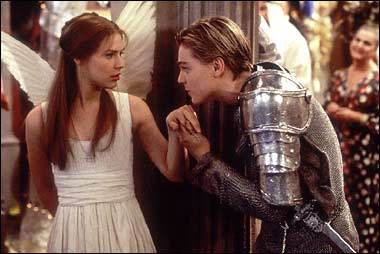
romeoA few weeks ago we watched Baz Luhrmann’s version of Shakespeare’s Romeo and Juliet, and it was as I remembered it: Just a hoot. So over the top, with slow motion, fast motion, quick cuts, and wonderfully explosive performances, particularly from Harold Perrineau as Mercutio, John Leguizamo as Tybalt, and Miriam Margolyes as the nurse. In fact their performances reminded me (again) of the lack of energy and chemistry between Claire Danes and Leonardo DiCaprio – or, perhaps, that those minor roles are just so much more fun and allow the actors to stretch and preen and, well, just carry on. More fun to be Mercutio, I think, than a star-crossed lover.

We watched this movie since our son’s studying the play in 6th grade, and the class has talked some about this version but not seen it. They’ve been given the task of re-creating a scene from the play – he and his mates took on the opening melee between the Capulets and Montagues – and I wanted to share with him what Luhrmann did for Act I, scene i, with helicopters, gunfire, Tybalt’s slicked back hair, and the exploding gas station. It is wild, wild, wild – a set piece that gives the viewer an immediate sense of what’s to come. Cartoonish, sure, but also riveting and so fun.

Initially, I hesitated showing that version of the play to our son, since I wanted to give him a chance to build his own version – to take the play’s rich language and let it paint pictures in his mind, without hints or outright suggestions. In fact, there’s always that tension with Shakespeare or other great authors put to film: To watch the movie or not? Does that take away from reading the text or add to it?

Maybe we hit this one just right: Our son and his classmates had already done some good thinking about their fight scene and had come up with a premise of dueling pirate clans, with our boy delivering the opening speech drinking from a bottle of rum. What a great, great idea – and so we watched the Luhrmann film as just another approach, how that director had imagined the play. As Ed Cumming wrote in the Telegraph two years ago, “The joy in a great Shakespeare performance…is in seeing the decisions the actor and director take with the text, how they make concrete the page’s ambiguities.” To see that film – or any version of the play – is to see those decisions and get the chance to evaluate their effectiveness. Did those collective decisions get the story across? That’s always a great question to debate, particularly with a version as outlandish as Luhrmann’s.

Posted in Classroom, Teachers, Teaching | Tagged , , , , , , , , , | Leave a comment

Opportunities for American Indian Education

coreconnectionMy recent article for ASCD. You can also see it here.

With the implementation of the Common Core State Standards, states and districts have worked to determine the alignment of their current curriculum and instructional materials to the standards, but at times these alignments remain in various stages of completion or lack the specificity that teachers want.

This has certainly been true as it relates to standards-aligned curriculum that states and districts have developed in the area of American Indian education. It’s often no fault of those at Indian education state offices, where staffing tends to be limited to just one person and that individual has a variety of duties to fulfill beyond the scope of curriculum and instruction. In addition, state offices of education have had to be strategic about their rollout of the standards, with an obvious focus on English language arts/literacy (ELA) and on mathematics. If states already had instructional materials in place for American Indian education, aligning those materials with the Common Core was not a priority for many of them.

That’s not true for the state of Montana. In fact, when people in other state offices are asked which states are doing an effective job of connecting their Indian education efforts with the Common Core standards, over and over people point to Montana. Denise Juneau, superintendent for Montana’s Office of Public Instruction (OPI), said, “We have great things happening in classrooms all across Montana.”

Montana was one of the first states to emphasize the importance of American Indian education and culture. In 1972, the state constitution affirmed the commitment to preserving the integrity of tribal cultures in Montana, and in 1999, the Indian Education for All Act was passed by the state legislature. The act became fully funded in 2005, and with that funding came the development of curriculum, with many lessons, units, and resources, and a lot of professional development. Juneau, a member of the Mandan and Hidatsa tribes and the first American Indian woman elected to a statewide position in Montana, said, “For the first time ever, we had to teach about Indians, and we’ve had a lot of professional development for teachers since that time.”

Lynn Hinch, assistant division administrator at OPI, concurred. “When we started,” she said, “teachers and school districts needed stuff, and they understood the obligation to Indian Education for All. So, we brought groups of teachers together to develop lessons.”

When the standards were introduced to states for adoption, Montana was very deliberate in its review. The process was similar to how the state developed the Indian education materials and included input from teachers across Montana. Juneau said her office worked with educators about adopting the Common Core, but she wondered if teachers could gather around it.

The public instruction office also worked with educators to identify and discuss the impact of the new standards on materials and resources for American Indian education, which the state had been developing and making available to Montanan educators for years. Jael Prezeau, an administrator at OPI’s standards and instruction department, talked from the district perspective about the Montana Common Core, as it was now called, and the immediate connection that her colleagues made to the state’s commitment to Indian education. “When we started to look at the Common Core, people asked, ‘Well, where is the Indian Education for All?’ It was very telling to me that Indian Education for All was very deeply in place [in our state]. Teachers wanted to know what we are doing for Indian education in the context of the Common Core.”

To connect Indian education and the Montana Common Core, OPI brought teacher groups together to develop materials that would assist their statewide colleagues with alignment and implementation. OPI awarded grants to districts as they took the state-level work and refined it further at the district level. “We had a variety of approaches,” added Juneau. “We were always trying to give back to the classroom.”

One of the districts that worked with OPI was Columbia Falls Schools. Dot Wood, curriculum director at the four-school district in Columbia Falls, said that “our Indian education implementation before the Common Core used many good general resources.” With the implementation of the Montana Common Core, Wood and her colleagues at the district put together an implementation framework using materials that the state offered. Then they formed teacher teams and trained them in unpacking the standards.

Knowing how important Indian education is to Montana, Wood indicated that “it made sense to look at the Common Core blended with Indian education.” With this in mind, the district applied for an OPI grant and used the funds to obtain assistance from Tammy Elser, who authored the OPI publication The Framework: A Practical Guide for Montana Teachers and Administrators Implementing Indian Education for All.

With OPI’s generous funding and continued support, Wood, Elser, and team members at Columbia Falls developed a comprehensive professional development plan for the current school year, with training for different grade bands and targeted assistance to middle and high school social studies teachers. “Our primary focus was Common Core implementation but through the vehicle of the Indian Education for All units and materials,” said Wood. “There was very direct work with writing development, with reading strategies—all of which were embedded in the literature and literacy activities already in the lessons.”

Last fall, teachers implemented one of the state’s Indian Education for All units, with the Montana Common Core aligned to the activities within the unit. After a debriefing and conversations this past winter about what worked and what didn’t, teachers will implement another unit this spring.

“Another element in our future implementation,” stated Wood, “is a summer institute this year, funded through the OPI grant. Our Indian Education for All committee . . . will work through our current district Indian Education for All implementation plan and update it based on the work that emerges from the spring professional development sessions. It will lay out our district-level implementation plan for the next several years and will include Montana Common Core standards in ELA and math as a foundational guide grounding our Indian Education for All work.”

“It’s really phenomenal to see how far our state has come in a short amount of time,” said Juneau. “Indian Education for All has been a great thing that has happened in our state. And we now have lessons that other states can use.” In fact, the state not only has literal lessons that other states can use—curriculum materials that align American Indian education topics and ideas about implementing the Common Core State Standards—but also larger lessons. Other states could benefit from Montana’s example of forming a close collaboration between the state office and multiple school districts, providing funding to school districts to engage frontline teachers in the work, and framing this new work (the standards) in the context of past work (Indian Education for All) to ensure alignment from the very start.

Posted in Federal policy, School district, Teachers, Teaching | Tagged , , , , , | Leave a comment

Digital resources in the classroom

05tablet-2-articleLargeI had a revelation the other day, when I was observing a 7th grade math class. The teacher broke up the class into small groups, and while one group went to work with her at her table, others went off to different corners of the room, to do a variety of activities in these groups. I was drawn to one group that picked up iPads and dove into a variety of math fact games on these tablets, the games focused on fractions. I said to myself: So, this is the future. This is what a classroom will increasingly look like over the next several years, with teachers using tools like the iPad to differentiate instruction.

That same week I attended an ed tech conference put on by the Saylor Foundation and heard a speaker state, in so many words, that education problems will be solved in the future with better software, rich content, and dynamic delivery mechanisms. Nothing about teachers in that sentence. It was about code, knowledge, and tools.

OK, I get why we need to think about and push towards that vision: Some education will thrive with improvements in those areas. With the right learners – motivated adults, for example – a dynamic online course, sans teacher, will work. I thought again about that 7th grade class. Yes, some students were off on their own, engaged thoroughly in digital games, getting the right answers and moving through various levels. No doubt the game was collecting data about each learner – about what they were getting correct and incorrect – and whether with this version of the game or its next iteration, those data could be used to customize the game and make the learning even more specific to the learner. OK, I see where the code/knowledge/tools vision is going – maybe where it’s already arrived, with the sort of courses and learning offered by Saylor and other like-minded places.

But in that 7th grade class the other day, I could not help but watch the teacher interact with the four students at her table and think how important she was to their learning. They were with her for a reason – perhaps they needed the extra push that she was able to provide, that they could not get from an iPad game. Perhaps they were learners that just did better with someone face-to-face. That’s why I struggle with the code/knowledge/tools future vision, one that does not depend on the skilled teacher. Yes, let’s keep pushing the boundaries with digital tools and content for teaching and learning – but let’s not forget, for some students, the importance of the teacher. I wonder how, in the K-12 world, these two sides will shake out.

I got the above image from here.

Posted in Classroom, School, Teachers, Teaching | Tagged , , | Leave a comment

Teaching and watching plays with students

I had an ugly time at college figuring out a major. I started with chemistry and then mathematics but got hammered in even the most basic courses in both, which did not bode well for majoring in either. Overall, I was a pretty pathetic student – not very driven, easily distracted by the multitude of distractions that occur on any college campus. Nothing lit my academic fire.

Don Pease & his book on Dr. Seuss

That was until I took Don Pease’s course on modern American drama. I had heard great stuff about this wildly animated, entertaining English professor and decided to take his course on Albee, Williams, Miller, O’Neill, Kopit, and others. The course not only lit that fire, but it also ignited a love of theater that’s burned to this day. (OK, OK, I’ll put out the fire imagery.) Granted, we were just reading the plays in that course, not seeing them, but Don Pease and his focus on the language of each play – the sort of theatrical vocabulary that each text possessed – helped me understand that layer of the play, language as the play’s bedrock, on which a production can be built.

Thanks, Don, and other college professors, such as Peter Saccio and his Shakepeare courses, for when I taught high school, I made a habit of taking my students to the theater – to Providence’s Trinity Rep to see Ma Rainy’s Black Bottom, for example, or to DC’s Shakespeare Theatre to see The Taming of the Shrew. But those trips were extracurricular, not integrated into my class, and it was not until I had a summer internship in the education department at the local Round House Theatre that I began to hatch an idea, one that I hoped would provide for my students a deep dive into a play and its production.

Carter Lewis

The summer before school started, I scanned the seasons that DC area theaters were advertising, wanting to find a show that was fairly contemporary and appropriate for high school sophomores. Round House was putting on a relatively new play by Carter Lewis called An Asian Jockey in Our Midst – it’d been produce three other times – and my relationship with the education folks at that theater allowed me, as a part of my unit, to develop several great insider moments for my students: For example, we attended a rehearsal of the show and had the chance to talk with personnel involved with the production. We also tracked down Carter Lewis’ contact info and had some back and forth with him via email.

It was an exciting and multidimensional unit/experience – to study the play and its language, to see it in production when we went to that rehearsal, to get the inside scoop from Round House folks and the playwright himself, and finally to see the final production, with all of the back story that we’d already experienced. To approach the play from multiple viewpoints – the text, an interim version of the production, the final version of it – my students understood the iterative process that plays undergo, that the playwright’s text is not always what appears on stage. They understood the highly collaborative nature of theater, with its many voices, even theirs as audience members. And while we reveled in the language when we read and studied the play, that was just a precursor to the experience of seeing the play on stage, the true home of any play.

Maybe that’s what I’ll finish with: The thrill of live theater. All students need to have that chance, to see something on stage that takes their breath away. And it’s made doubly exciting when they can connect that breathlessness to something they’ve studied at school. Suddenly and wonderfully, their study leaps off the page. I remember the faces of my students on the day after we saw a production of something we were reading – great grins of realization, knit brows of contemplation – and then the hands started shooting up, with a frenzy of questions and comments. The thrill of live theater, yes – and the thrill of class the day after.

I got the image of Don Pease from here. The image of Carter Lewis came from here.

Posted in Classroom, School, Teaching | Tagged , , , , , , , | Leave a comment